


How to choose a high-end sofa without trying it: comfort, proportions and materials that really matter
A sofa can be beautiful, impeccably made and still not be the right sofa for you.
The reason is simple: we tend to choose it as an object to look at, whereas we will mainly sit on it, stretch out, entertain guests, read, talk, watch films and spend time with the family.
Before comparing models, colours or upholstery, it is therefore worth asking a more personal question:
“How do I want to feel when I sit on my sofa?”
Trying a sofa in a showroom provides an immediate impression, but it does not always reveal how comfortable it will be in everyday life. Conversely, buying a high-end sofa online does not mean choosing blindly: dimensions, seat depth, padding, backrest angles and configuration options provide a great deal of useful information.
This guide will help you create a genuine comfort profile, allowing you to understand what suits you before choosing a particular model.
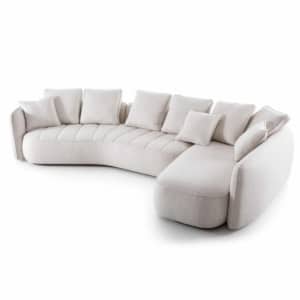
Start with how the sofa will actually be used, not with the model
The first consideration is not the sofa’s style, but how you intend to use it.
A sofa designed primarily for entertaining does not necessarily require the same features as one on which you hope to stretch out every evening. Likewise, a seat that feels perfect for a tall person may be too deep for someone shorter.
| Main use | Features to prioritise |
|---|---|
| Conversation and entertaining | A relatively supportive seat, a sufficiently upright backrest and a depth that makes standing up easy. |
| Watching films and relaxing | A deeper seat, an enveloping backrest, generous cushions or adjustable supports. |
| Reading | Good lumbar support, a usable armrest and the ability to change position easily. |
| Everyday family life | Upholstery suited to frequent use, generous modules and maintenance compatible with your lifestyle. |
| Stretching out or occasionally sleeping | Sufficient usable length, unobtrusive armrests and an even seating surface. |
There is no single type of comfort that is perfect for everyone. There is only comfort suited to a particular person, posture and way of living.
Your comfort profile: the specifications that really matter
A sofa’s technical dimensions are not merely numbers. Each one has a practical effect on posture and on how the sofa feels when you sit down.
| Technical specification | Effect in everyday use |
|---|---|
| Seat height | A low seat creates a relaxed posture; a higher seat makes it easier to move from sitting to standing. |
| Usable seat depth | This determines whether your feet rest naturally on the floor or whether your position becomes more reclined and informal. |
| Backrest height and angle | These influence the support provided to your back, shoulders and, where applicable, your head. |
| Armrests | Their height, width and padding affect comfort as well as the amount of space actually available for sitting. |
| Suspension | It distributes weight and contributes to the seat’s initial softness, support and stability. |
| Padding | Foam, fibre, down and feathers can be combined to achieve different balances between support and softness. |
| Loose or integrated cushions | Loose cushions offer greater flexibility and personalisation, while integrated elements retain a more orderly appearance. |
Consider the Escape sofa, for example. Its seat depth of approximately 65 cm and seat height of around 42 cm suggest a comfortable and relaxed position without necessarily creating the exceptionally deep feel of a lounge sofa.
Those two measurements are already more informative than a generic description such as “comfortable sofa”.
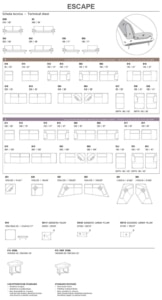
Overall depth and seat depth are not the same thing
This is one of the most common sources of confusion.
Overall depth includes the backrest, its structure and sometimes decorative elements. Usable seat depth is the actual space between the backrest and the front edge of the seat cushion.
Two sofas with the same external depth can therefore provide very different sitting positions.
To understand which depth suits you, carry out a simple test using your current sofa:
- Sit in the position you adopt most often.
- Measure the distance between the backrest and the front edge of the seat.
- Note whether your feet rest naturally on the floor or whether you prefer to tuck your legs beneath you.
- Ask yourself whether you would like a few centimetres more room or, conversely, a shallower seat.
This gives you a personal reference point, which is far more useful than an abstract definition of comfort.
Foam density does not directly indicate firmness
It is sometimes claimed that denser foam is necessarily firmer. This is not correct.
Density mainly indicates how much material is contained within a particular volume. It can provide useful information about the foam’s structure and durability, but it does not determine the final sensation on its own.
Comfort also depends on:
- the type of foam used;
- its elasticity;
- the thickness of the different layers;
- the presence of fibre, down or feathers;
- the suspension beneath the seat;
- the construction and upholstery of the cushion.
A seat can therefore be dense yet inviting, or less dense but comparatively firm. The entire system should be considered rather than one number in isolation.
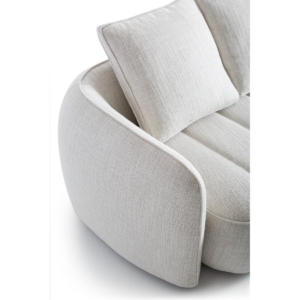
Do not measure only the sofa: measure the space that will remain around it
A sofa can fit inside a room and still be too large for it.
The right question is therefore not merely “How large is the sofa?”, but also:
- how much space will remain in front of and behind it;
- whether circulation routes will remain clear;
- whether doors, windows and other furniture will still be easy to use;
- whether the coffee table will remain accessible;
- whether the composition will look balanced from the entrance to the room;
- whether the sofa will create a visual or practical obstruction.
You can mark out its footprint on the floor using removable masking tape, sheets of paper or cardboard. Our guide to photographing and measuring a room with your smartphone explains how to send us useful information without specialist equipment.
A few clear photographs and several essential measurements are usually enough. We do not expect you to provide a professional architectural survey.
Straight, corner, modular or curved: choose the geometry before the style
The shape of a sofa determines how people use and perceive the room. It also affects conversation, circulation and the direction in which attention is naturally focused.
| Configuration | When to choose it | What to check |
|---|---|---|
| Straight sofa | To maintain a simple, flexible composition that can easily be combined with armchairs. | Usable length, the genuine number of seats and its proportion in relation to the wall. |
| Corner sofa | To define a generous relaxation area or make use of a corner of the room. | The direction of the corner, circulation routes and the true footprint of the chaise section. |
| Modular sofa | To create a personalised arrangement that may also be adapted over time. | The dimensions of each element, the connections and the possibilities for reconfiguration. |
| Curved sofa | To create a fluid, sociable and visually expressive composition. | Maximum depth, the remaining space behind the curve and the main circulation routes. |
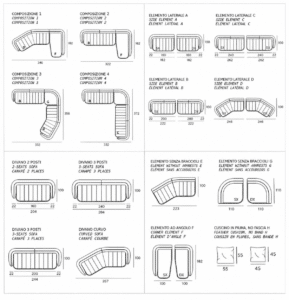
A modular model such as Heaven can be used to create straight, corner or curved compositions by combining different elements.
A sofa such as Puzzle places greater emphasis on the geometry of the composition and the visual continuity of the leather upholstery. The Wave sofa, meanwhile, turns the curve itself into an architectural feature.
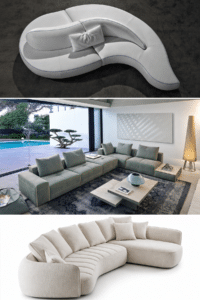
A right- or left-hand chaise should be drawn, not merely described
Expressions such as “right-hand corner”, “left-hand corner”, “right-hand chaise” and “left-hand chaise” can be interpreted differently depending on whether the sofa is being viewed from the front or from the seated position.
To avoid any ambiguity, the safest method is to:
- draw the room from above;
- mark the doors and windows;
- draw the sofa in its intended orientation;
- add an arrow showing the main entrance to the room;
- include a photograph taken from the principal viewpoint.
A very simple sketch is better than a complicated written description. It does not need to be precise or attractive: it only needs to make the orientation clear.
An adjustable seat can change the sofa’s function
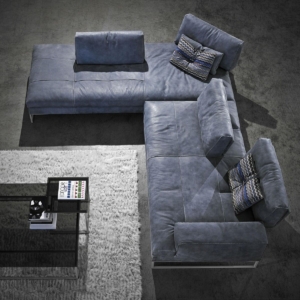
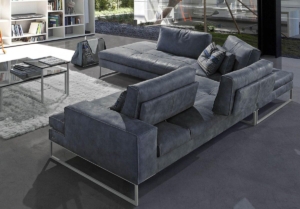
Some sofas allow their backrests to slide or be repositioned. This mechanism genuinely changes the usable seat depth rather than merely altering the sofa’s appearance.
On the Sunset sofa, moving the backrest can vary the seat depth from approximately 66 to 106 cm.
In its shallower position, the sofa encourages a more upright posture suited to conversation. When the backrest is moved backwards, the seat becomes considerably more generous and closer to a lounging surface.
This flexibility can be particularly useful when the same sofa needs to serve different purposes throughout the day.
Leather or fabric: the real question is not “delicate or durable”
Many customers hesitate to choose leather because they assume it is automatically more delicate than fabric. In reality, good-quality leather, correctly selected and cared for, can retain its beauty, elasticity and character for many years.
Leather is not indestructible, but neither is fabric. A sharp object, metal zip, impact or deep abrasion can damage both a leather sofa and a fabric one.
The right question is therefore not simply “leather or fabric?”, but:
“Which leather or fabric, with which finish, for which type of everyday use?”
| Situation | Leather | Fabric |
|---|---|---|
| Cuts and deep scratches | These may leave a permanent mark. | They may cut, pull or fray the fibres. |
| Liquids and stains | A protected finish usually makes prompt cleaning easier. | The result depends on the fibre, weave and any stain-resistant treatment. |
| Ageing | Fine leather can develop an elegant and individual patina. | A good fabric can retain its colour and structure for many years. |
| Children and pets | Choose a sufficiently protected finish suited to the intended use. | Choose a tightly woven, durable and easy-to-maintain material. |
| Sunlight and heat sources | Avoid intense, prolonged exposure that may dry or discolour the surface. | Some fibres and colours may also fade over time. |
| Maintenance | Gentle dusting and products specifically suited to the particular type of leather. | Regular vacuuming and cleaning in accordance with the manufacturer’s instructions. |
Aniline or particularly natural leather highlights the grain, variations and authentic characteristics of the hide. It offers an especially refined feel, but generally requires greater care.
Pigmented or protected leather is more uniform and often easier to live with in an interior subject to frequent use. Neither type is inherently “better”: they satisfy different expectations.
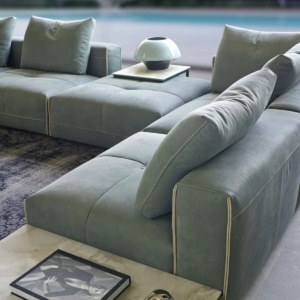
On a model such as Puzzle, the quality of the leather, the design of the stitching and the precision of the construction directly influence both the perception of the volumes and the sofa’s long-term appearance.
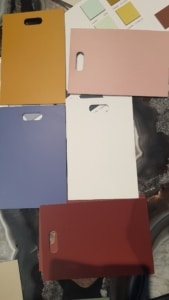
The colour on your screen is not yet the colour in your living room
The colour perceived on a screen depends on numerous factors: brightness, device settings, the original photograph, the time of day and the surrounding colours.
A grey may appear bluer, a beige warmer and a brown leather darker depending on the screen being used. Even a physical sample will look slightly different in natural daylight, beneath a warm lamp or under cooler artificial lighting.
When colour is an important part of the decision, we recommend that you:
- place the sample close to the floor and walls of the room;
- look at it in the morning, afternoon and evening;
- compare it with the curtains, rug and other finishes;
- avoid judging it solely beneath direct artificial light;
- allow yourself a few days before confirming the final finish.
Where necessary, Italy Dream Design can arrange to send leather or fabric samples, enabling you to assess the material and colour more accurately.
The sofa must fit into the living room, but first it must fit into the property
A composition may be compatible with the dimensions of the living room yet fail to pass through a doorway, corridor, staircase or lift.
Before ordering, it is therefore helpful to check:
- the width and height of the entrance door;
- the narrowest point of any corridors;
- corners and changes of direction;
- the internal dimensions and door opening of the lift;
- the presence of narrow staircases or obstructive handrails;
- whether the feet, armrests or other components can be removed;
- the dimensions of the largest package, not only those of the assembled sofa.
Modular sofas have an important advantage in this respect: the completed composition can be generous, while each individual module remains easier to transport separately.
You do not, however, need to conduct a complete technical survey yourself. A few measurements, a simple sketch and photographs of the most difficult access points are usually enough for us to understand whether further checks are needed.
The checklist to complete before ordering
Before confirming your choice, check the following nine points:
- Main use: conversation, relaxation, reading, family life or resting.
- Seat height: low enough to feel comfortable, but not too low for your needs.
- Usable seat depth: compatible with your height and preferred posture.
- Back support: lumbar area, shoulders and, where required, head.
- Configuration: straight, corner, modular or curved.
- Circulation: the space in front of, behind and around the sofa.
- Upholstery: suited to the intended use, maintenance requirements and light in the room.
- Colour: ideally verified using a physical sample.
- Access: doors, stairs, lift, corridors and package dimensions.
If some of these points are not yet clear, there is no need to worry. Their purpose is not to make the purchase more complicated, but to help us identify the few pieces of information that genuinely matter for your project.
Frequently asked questions about choosing a sofa online
How can I tell whether a sofa will be comfortable without trying it?
Compare its seat height, usable depth, backrest, padding and suspension with a sofa you already know. Photographs, measurements and a description of your habits can then be used to refine the choice.
What is the ideal seat depth?
There is no single ideal depth for everyone. A shallower seat generally encourages a more upright posture, while a deeper seat is better suited to a relaxed or semi-reclined position. The user’s height and the presence of back cushions must also be taken into account.
Is denser foam necessarily firmer?
No. Density and firmness are different properties. The final sensation depends on the type of foam, its elasticity and thickness, the comfort layers and the sofa’s suspension.
Is leather more delicate than fabric?
Not necessarily. Quality leather suited to its intended use can age extremely well. Cuts and deep abrasions can, however, damage both leather and fabric. It is important to compare the particular qualities and finishes rather than only the two broad categories of upholstery.
How can I avoid confusing a right-hand and left-hand chaise?
The safest solution is to draw the composition from above and include a photograph of the room. A drawing eliminates any ambiguity caused by the viewpoint used to define right and left.
What should I send you when asking for advice?
A few general photographs of the room, its principal dimensions, the position of the doors and windows, and an indication of how you intend to use the sofa are sufficient in most cases. You do not need technical expertise or a complicated set of documents.
A sofa chosen remotely, but never without dialogue
Choosing a high-end sofa online should not simply mean adding a large object to a basket without assistance.
It should instead be a process in which technical information, photographs, samples and dialogue gradually replace uncertainty with concrete evidence.
Our guide to buying high-end furniture online also explains how to evaluate a product, a retailer and the associated services before making an important decision.
You can explore our selection of Italian designer sofas or contact us to discuss a composition, seat depth, upholstery or colour.
You do not need to measure everything or understand the technical terminology.
Simply send us the information you already have. We will then explain clearly whether an additional photograph or measurement would genuinely be useful.
Email:
info@italydreamdesign.com
Telephone:
+39 347 796 0415
Contact:
send us a message using our contact form
The real objective is not to choose the largest or most spectacular sofa, but the one that will continue to feel right, comfortable and naturally integrated into your everyday life for years to come.